
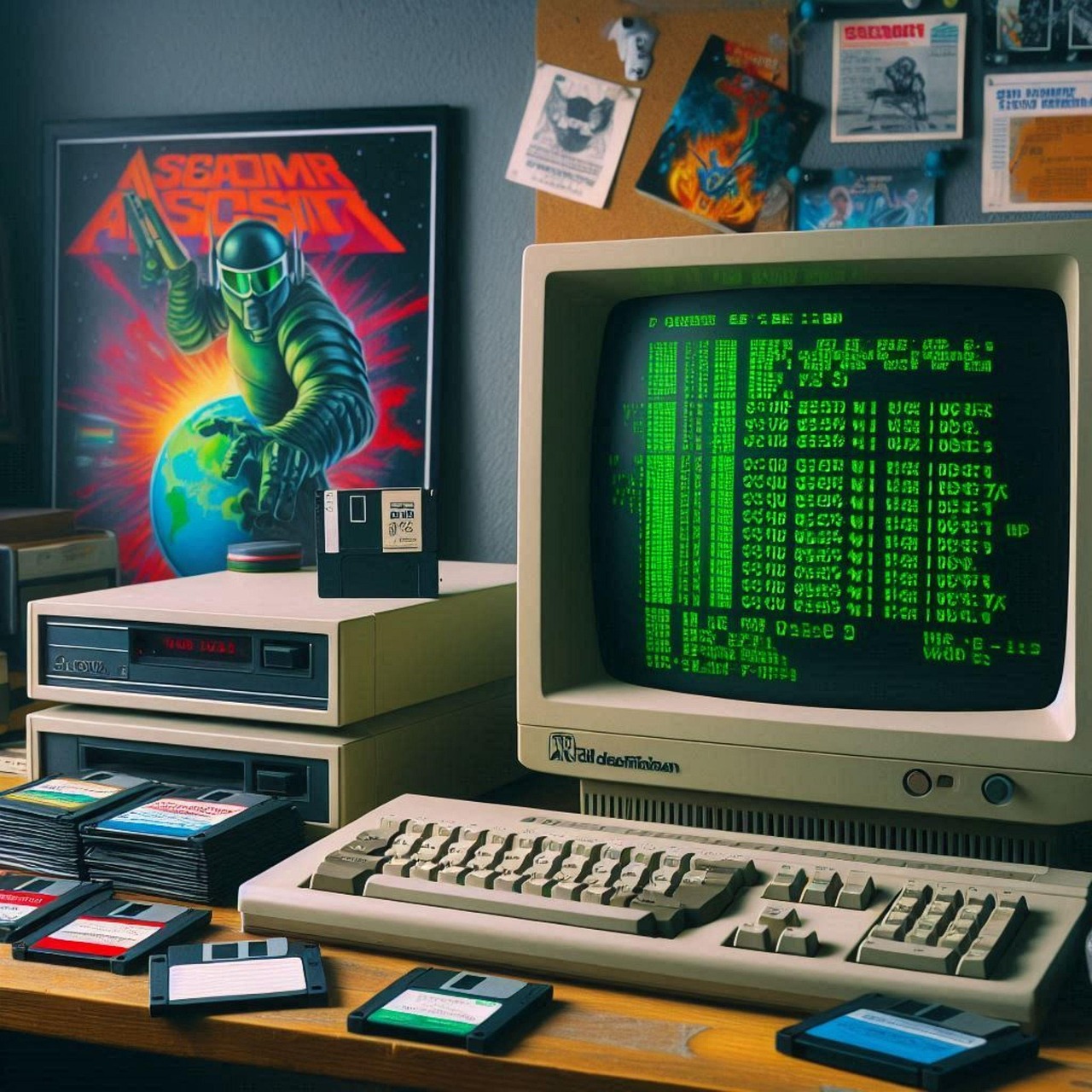
I need you to think about something for a second. We live in a world where technology has become incorporated into every single part of our life. But how did this all begin?
Because here’s the thing. Most people never really take the time to stop and think about it. You wake up, you reach for your phone, you open your laptop, and your day is in motion. And there’s nothing wrong with that at all — that’s just how life works when something becomes a normal part of your everyday routine. But every now and then I think it’s worth pausing and asking — how did we get here? Who made this possible? What did the world look like before any of this ever existed?
And when you actually sit down and explore those questions, what you find is not some cold, technical sequence of inventions. What you find is people. Warm, brilliant, sometimes heartbroken people who cared so deeply about an idea that they gave years and years of their lives to it. People who in some cases never got to see their work pay off while they were still alive. I find that so moving. And I really hope that by the time you finish reading this, you understand exactly how I felt.
It All Started With a Very Old Problem
To understand how computers were invented, you first have to understand the problem they were able to solve. And that problem goes back further in time than you might think.
For most of human history, if the world needed a complicated math problem solved — the kind that engineers and scientists and ship navigators and military planners depended on — the answer was to sit a person down with a pen and paper and let them work through it. And not just one person. Sometimes whole rooms full of people, all working together on different pieces of the same enormous calculation.
Those people were actually called computers. That was their job title. And many of them — a fact that doesn’t get talked about nearly enough — were women. Smart, careful, dedicated women who took enormous pride in getting things right. They checked each other’s work. They understood that the numbers they were producing actually mattered out in the real world. They cared.
But even the most careful person gets tired. Even the most dedicated worker loses focus after hours of the same painstaking work. And small mistakes in math have a way of turning into big problems when those numbers are being used to navigate ships or calculate where artillery shells are going to land. As the world kept growing and the problems kept getting bigger and more complex, the people who were paying attention started wondering — could a machine do this? Could something be built that didn’t get tired, didn’t lose focus, and didn’t make the kinds of small human errors that were costing so much?
That question is really where everything starts.
Charles Babbage — The Dreamer Ahead of His Time
The first person to genuinely try to answer that question with an actual physical machine was a mathematician named Charles Babbage, living in England in the early 1800s. And I want to tell you a little bit about who Babbage was as a person, because I think it will help you to appreciate his story so much more.
Babbage was the kind of person who could see something so clearly in his own mind that the rest of the world almost didn’t matter. Babbage had a vision and he held onto it even when everything around him seemed to be siding against him. There’s something really motivating about that kind of determination, especially when you understand how difficult his journey was.
In the 1820s Babbage designed a machine he called the Difference Engine. The whole idea was simple and beautiful — a mechanical device that could do math on its own and print out the answers directly, so that human error couldn’t sneak into the process at any point. He got some funding from the British government and started building it. And then reality showed up. The parts needed to be crafted with a level of precision that the tools of the 1820s simply couldn’t deliver reliably. Things kept going wrong. Money ran out. The Difference Engine was never finished in his lifetime.
But Babbage being Babbage, he didn’t stop there. He went further and designed something even bigger that he called the Analytical Engine. And when you understand what this machine was designed to do, it is honestly kind of jaw dropping for something dreamed up in the 1830s. It had a part for holding numbers in memory. A separate part for doing operations on those numbers. It could receive instructions through punched cards. It could even make simple decisions and go down different paths depending on what a calculation told it. That is a computer. A real, genuine, general purpose computer — designed with gears and levers and metal, before electric power was even a common thing in everyday life.
He never got to build it. The world he lived in wasn’t ready. But the dream was real and it was written down and it mattered more than he probably ever knew.
Ada Lovelace — She Saw Further Than Anyone
Working alongside Babbage was a mathematician named Ada Lovelace. And I want to take this section to talk about her because Ada Lovelace is a truly unique and special individual.
She was curious, sharp and deeply thoughtful about the bigger picture of things — not just what something was, but what it could eventually grow into. When she translated an article written about the Analytical Engine, she added her own notes to it. Those notes ended up being much longer than the article itself. In them she wrote something down that we would recognize today as the very first computer program — a clear, step by step set of instructions of how the machine could be directed to work through a specific calculation.
But what’s really amazing is that she wrote beyond the program itself. She understood that a machine which could work through logical steps wasn’t just a fancy calculator. She saw that such a machine could one day handle things that had nothing to do with numbers at all. Music. Language. Creative work. She was describing the future of computing — a future that wouldn’t actually arrive for well over a hundred years — and she saw it clearly enough to write about it with confidence and manifestation.
She wrote the world’s first program for a machine that was never even built, and she imagined a future that none of us would live to see for generations. That is a remarkable human being. And she deserves to be remembered as one.
Alan Turing — The Man Who Defined What Computing Really Means
Moving into the 20th century, a mathematician named Alan Turing steps into our story in the 1930s and what he gave to computing is something that words honestly struggle to do full justice to.
In 1936 Turing published a paper where he described a theoretical idea — a kind of imaginary universal machine that could carry out any calculation if given the right instructions. It wasn’t something you could build in a workshop. It was a pure idea, a way of thinking about what computing actually is at the deepest level and what any real general purpose computer would need to be capable of. The framework he laid out in that paper is still the bedrock of how people think about computers and computation today. Nearly ninety years later.
During World War II Turing led the team at Bletchley Park in England that built machines to crack the Enigma code — the encryption system that Nazi Germany used to hide its military communications. The work that team did is believed by historians to have shortened the war and saved a very large number of lives. He gave something enormous to the world.
And then the world treated him terribly in return. The British government prosecuted him in the early 1950s because of who he was as a person, and he was subjected to treatment that was cruel and deeply wrong. He died in 1954 at only 41 years old. A man who had contributed so much to so many people deserved so much better than what he received. I think it’s right and important to say that clearly whenever we talk about him.
ENIAC — The Giant Machine That Proved It Could Be Done
By the mid 1940s, with World War II pushing the need for faster and more powerful calculation harder than ever before, two engineers named John Mauchly and J. Presper Eckert at the University of Pennsylvania were building the machine that would prove large scale electronic computing was truly possible.
It was called ENIAC — the Electronic Numerical Integrator and Computer — and it was finished in 1945. And I really want you to picture what this thing looked like because I think it makes the journey to where we are today feel even more remarkable.
ENIAC took up an entire big room. It weighed around 30 tons. It had roughly 18,000 vacuum tubes inside — small glass components that controlled electrical signals but got very hot, burned out often, and needed to be replaced constantly. It used 150 kilowatts of electricity just to keep running. If you needed it to do a different kind of calculation you had to physically rewire parts of the machine which could take several days of careful work.
And yet — it was incredible. Problems that would take a team of human computers several weeks to work through could come out the other side of ENIAC in hours. It worked. It was real. And what it showed the world was that electronic computing at this scale wasn’t just a nice idea — it was something that could actually be done. That proof changed the direction of everything that came after it.
The Transistor — Tiny Thing, Enormous Difference
After ENIAC, computers were still very much things that only big institutions could own or operate. Universities, government agencies, large companies. The idea of a regular person having one in their home was still somewhere between a dream and a joke.
What started closing that gap was the transistor, invented in 1947 by three scientists — John Bardeen, Walter Brattain, and William Shockley — at Bell Labs. And I don’t think the transistor gets enough everyday appreciation for what it did, so let me try to give it some.
A transistor could do the same job as a vacuum tube — switching and controlling electrical signals, which is the basic thing that all computing depends on — but it was tiny, it was sturdy, it stayed cool, and it was cheap to make. As transistor technology got better through the 1950s, computers started shrinking. They became more reliable. They became more practical. The distance between a machine that fills a room and a machine that a person could own started shrinking along with them.
Then in the late 1950s something arrived that made everything move even faster. Two engineers working separately from each other — Jack Kilby at Texas Instruments and Robert Noyce at Fairchild Semiconductor — each figured out how to put many transistors and other parts together onto a single small piece of material. The integrated circuit. The chip. And once chips existed, the growth of computing power went from slow and steady to something almost hard to keep up with. More power in less space at lower cost, year after year after year, until the impossible started becoming the obvious.
The Day Computers Came Home
All of that history — every dreamer, every engineer, every late night and failed attempt and small breakthrough — was building toward a moment in the 1970s and early 1980s when computers finally came home. Literally.
The Apple II arrived in 1977. The IBM PC came in 1981. These were not powerful machines by any standard we’d use today. They were slow, had very little memory, couldn’t connect to the internet, and looked nothing like what we use now. But they carried something that none of their enormous ancestors had ever carried before.
An invitation to regular people.
Not to researchers. Not to governments. To families. To students. To small business owners. To anyone who was curious enough to want one. That invitation was new and it was important and it changed everything. People started learning to use these machines. Kids grew up with them. Software was written for them. Careers were built around them. And then the internet came, and then laptops, and then smartphones, and the story just kept going and going until it brought us here — to right now, to you reading this on whatever screen you have in front of you.
What I Hope Stays With You
Charles Babbage designed a computer before the world could build one. Ada Lovelace wrote its first program and imagined its future before either of those things existed. Alan Turing explained what computing actually is and gave far more to the world than it gave back to him. The engineers of ENIAC showed that it was all really possible. The inventors of the transistor and the chip made it small enough and affordable enough to belong to everyone.
Every single one of those people handed something forward. And at the end of that long, beautiful, sometimes painful chain of human effort is you and the device in your hands right now.
I think that’s one of the most quietly wonderful things in the world. Something so familiar, so ordinary feeling, carrying all of that history inside it without ever mentioning it. I hope this gave you a little window into that story and made you feel just a small piece of what I feel every time I think about it.
It means so much to me to share things like this with you. Thank you truly for reading and for being here. Take care of yourself out there.